Springs · Brampton
Garage Door Balance Adjustment
Released from the opener, the door will not hold anywhere. Lift it to hip height, take your hands away, and it sinks back to the concrete, gathering speed on the way down.
Garage Door Balance Adjustment
In plain words
The whole service is built around one simple test that door manufacturers and safety bodies describe the same way. With the opener released, the door is lifted by hand to roughly a metre off the floor and let go. A balanced door stays where it is. One that drifts upward is carrying too much spring tension; one that sinks is carrying too little. The technician reads that behaviour at several heights, checks the door is level across its width, and then adjusts the counterbalance a quarter turn at a time, testing to the manufacturer's specified height and tolerance, until the door meets that standard and moves smoothly.
How the visit goesOn cold mornings the door barely makes it up. The motor whines, the door crawls, and once or twice it has given up halfway. By afternoon, with the sun on the garage, it runs almost normally again.
Brampton
How the visit goes
Extension springs and their containment
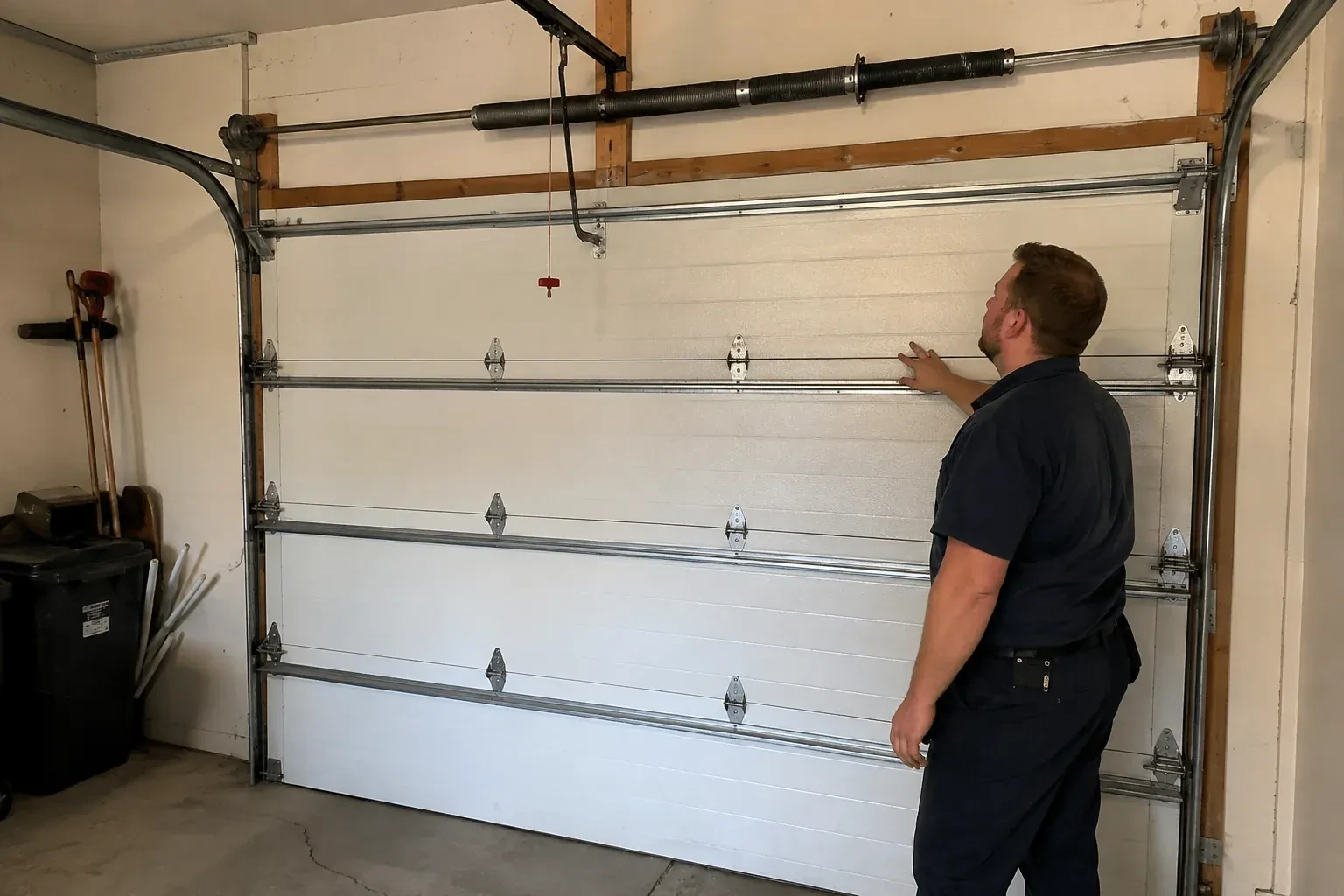
On a door with springs along the tracks, the check has a shape of its own. Both springs are compared for length and coil condition with the door closed, since a spring that has stretched further than its partner leaves one side of the door lighter. The pulleys are spun for wear, the cable clips on the track hangers are checked for equal position left and right, and the technician confirms a containment cable runs through the centre of each spring and is anchored at both ends. The bottom brackets and the S-hooks that set the spring tension are inspected for rust and deformation before any adjustment is planned.
Adding or releasing quarter turns on a torsion spring
With one winding bar seated firmly in the winding cone and a second ready, the technician loosens the cone's set screws and either adds tension by levering the bar upward or releases it by letting the bar down, always a quarter turn at a time, always with a bar in the cone. After each quarter turn the set screws are tightened onto the shaft, the clamp is removed and the door is lifted by hand to test. A door that sank now holds a little higher; a door that climbed now settles. On a two-spring door the same change is made to both springs so they share the load equally.
Cables and level, checked with a glance
Once a month, with the door closed and the light on, look up at the drums and down at the bottom brackets. Each cable should wrap its drum in a single neat layer with the same number of turns on both sides, and hang taut without fraying or rust at the bottom loop. The gap under the door should be even from corner to corner. On an extension door, glance at the two springs for equal length and confirm the containment cable still runs through each. These take less than a minute and tell you the door is still level and the counterbalance still shares the load evenly.
Garage Door Balance Adjustment
In the van
- Door scale
- Garage-door lubricant
- Replacement hinges
- Nylon or steel rollers
- Containment cables
What affects the quote
Same fees day, night or weekend
1Single or double door
A double door commonly carries more spring than a single, but the exact count follows the manufacturer's engineered hardware package for that door's weight rather than width alone: one, two or more torsion springs, or one or two extension springs per side. More springs means more adjustment and testing.
2Condition of cables and drums
Cables that are fraying or drums with worn grooves found during the check are recommended for replacement while the system is being set, and quoted as their own items.
3Corroded or seized fasteners
Set screws and cone screws that have rusted solid take time to free, and badly corroded hardware is replaced rather than reused, which shows in the parts list.
Garage Door Balance Adjustment: questions
What is the red cord hanging from the opener for?
It is the manual release. Pulling it disconnects the door from the opener's trolley so the door can be moved by hand, which is how the balance test is done and how you get the car out during a power cut. The industry standard calls for it to be red and reachable, no more than about six feet above the floor. Reconnecting is usually as simple as running the opener once.
How is door balance tested?
With the door closed, the opener is released so the door is free. It is lifted by hand to about a metre, then to fully open, and let go at each point. A door in balance holds its position; one that rises on its own is over-tensioned and one that drops is under-tensioned. The door should also move freely and no faster than the hand pushing it.
Should I lubricate anything after the visit?
A little, twice a year. Use a product sold for garage doors on the spring coils, hinge pins, roller stems, bearings and bracket pins, and cycle the door a few times to work it in. The tracks want a wipe, not a spray, because a slick track lets the rollers skid and gathers grit. Skip thick grease. Low friction is what lets the springs' setting hold true.
Springs & Hardware
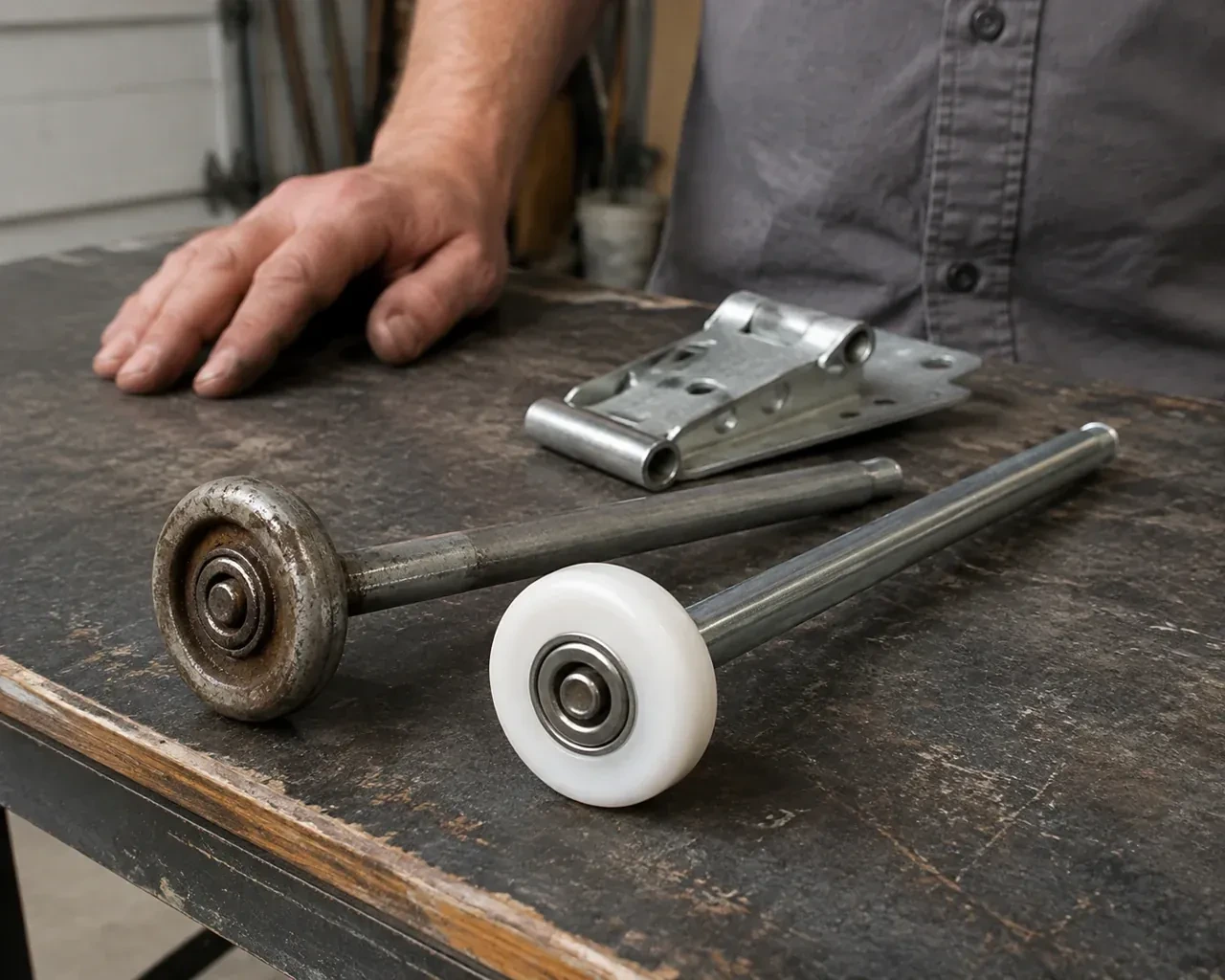
- Garage Door Hinge ReplacementAfter a cold night the bottom seal had frozen to the slab.
- Garage Door Track Repair or ReplacementAfter a decade of slushy winters the bottom foot of the track is flaking rust.
- Garage Door Cable ReplacementThe door went up as usual this morning, then stopped a third of the way with one corner higher than…
Garage Door Balance Adjustment near you
The services below are the ones we perform most often for garage doors in Brampton. Springs and cables top the list, followed by opener repairs, roller and hinge replacement, seal and weatherstrip work, balance and safety adjustments, remote programming and, when the time comes, new doors.